
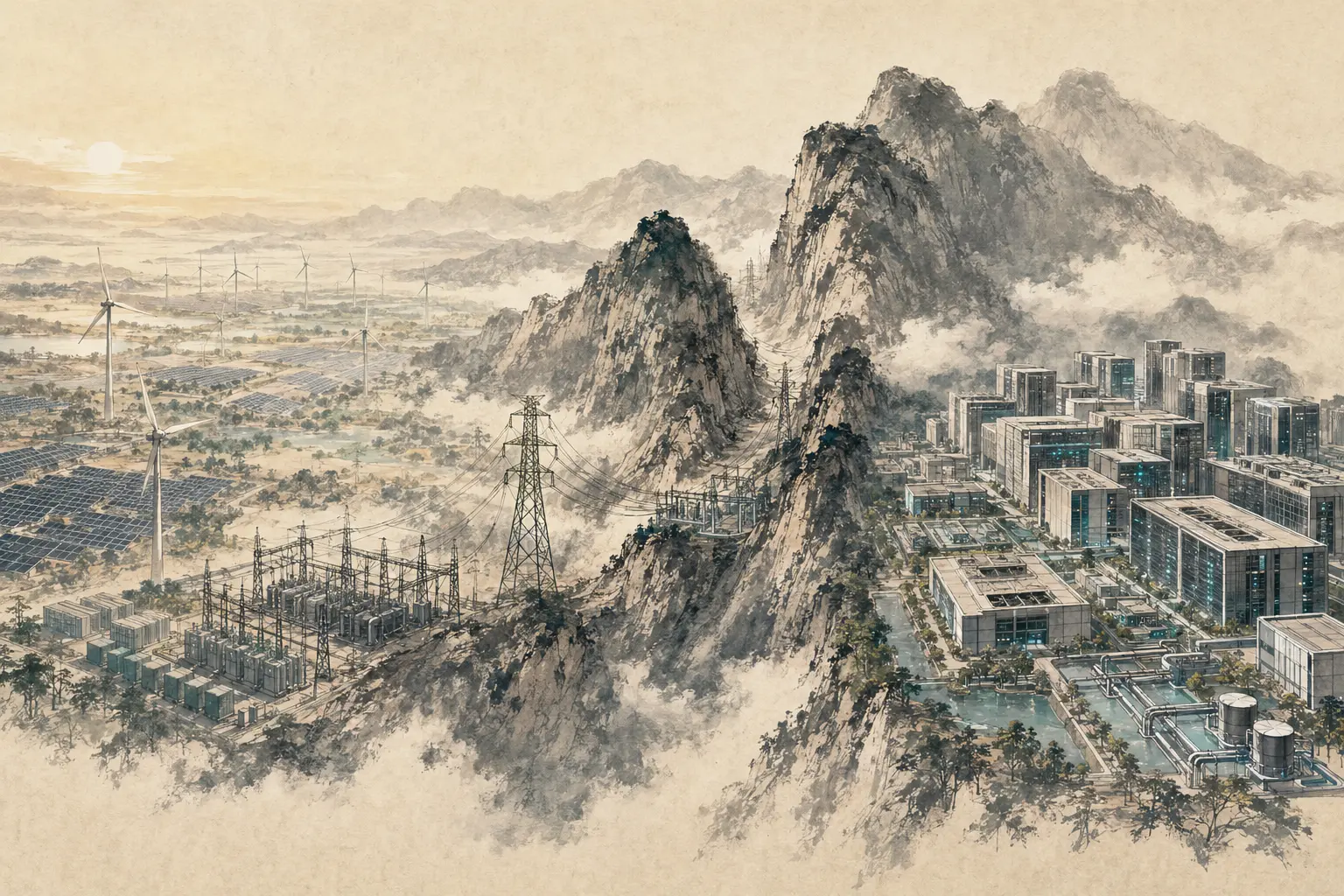
Modern ink-wash renewable energy and grid crossing mountains toward an AI compute city

INFORMATION ASYMMETRY 26 · AI STACK · 01 ENERGY

算电协同、绿电直连与人工智能的第一层

AI Runs on Electricity First

Explains AI's energy layer through grid location, interconnection, hourly power, green electricity, cooling and China's compute-power coordination.

Cross-checked against Chinese primary, industry, research and media sources · August 3, 2026 · Currency basis: the latest CFETS rate available on August 3, 2026—USD/CNY 6.7894, published July 31, 2026 · monetary amounts shown only in U.S. dollars
Topic typeInfrastructure × AI foundation

EDITORIAL THESIS

Core proposition

  1. 01

    AI's first constraint is not GPU count but stable, affordable power at the required place and hour. Energy volume, grid, price, carbon and cooling form one siting problem.

Swipe sideways for detail; tap the graphic to open it full size.

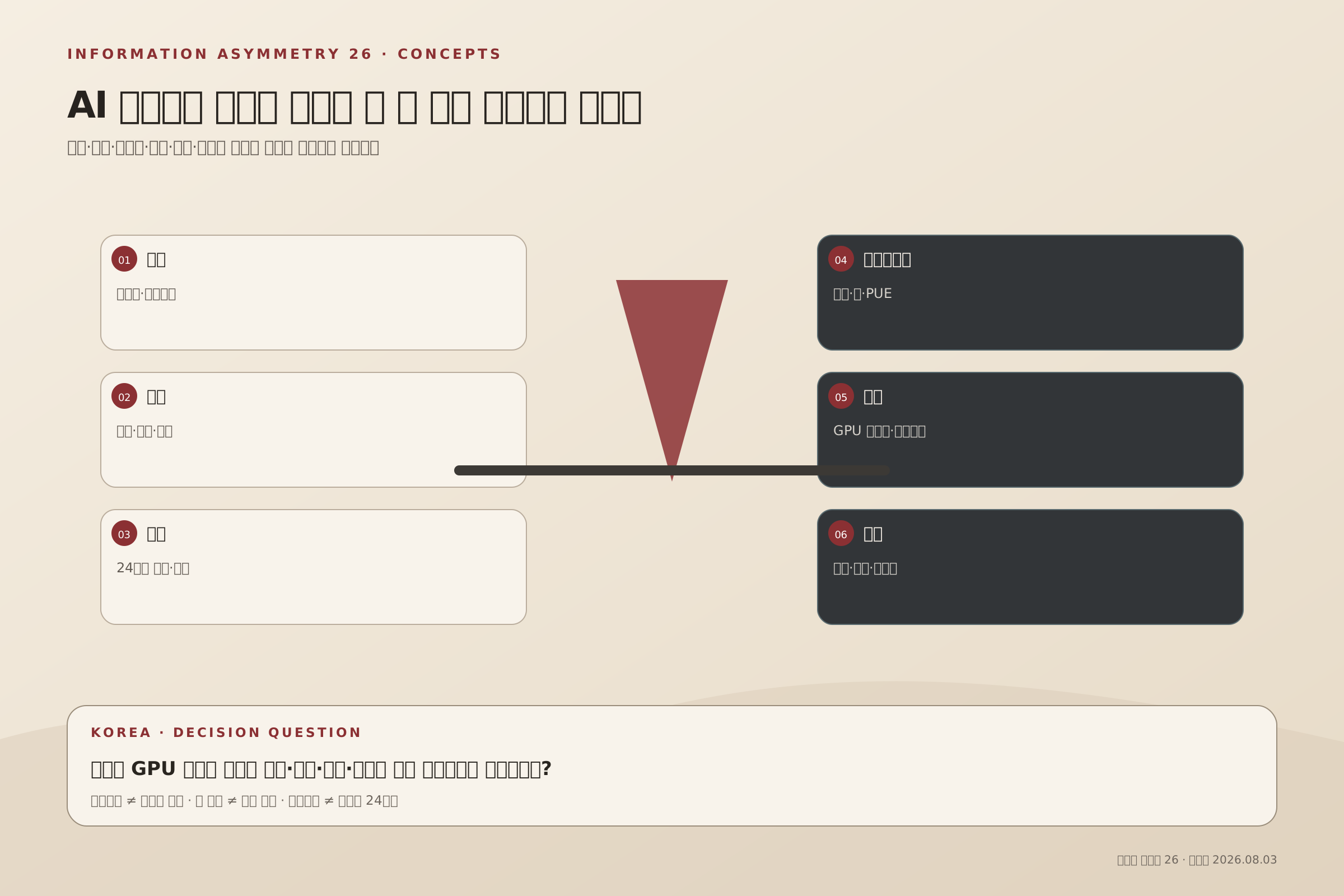
Infographic of the concept, operating structure, constraints and Korean response for AI Runs on Electricity First
26 · Operating structure — AI Runs on Electricity FirstA Korean-language graphic summarizing the concept, China’s operating system, constraints and Korea’s decision question.Download high-resolution SVG

CHINA SYSTEM · OPERATING LOGIC

Read the concept through its operating structure

01

AI power is about time and place

Training creates dense loads and inference varies all day. National generation does not guarantee nearby substations, transmission, reserves or timely interconnection.

02

China coordinates compute and power

Compute-power coordination links facility planning and operation with generation, grids, markets and demand response. Chinese compute centers used about 170 TWh in 2025.

03

Green certificates differ from hourly electricity

Direct green connections, market contracts, certificates, storage and grid backup are different tools. Verify hourly matching, additionality, losses and backup emissions.

04

Cooling links power, water and chip performance

High-density racks drive cold-plate and immersion cooling. Low PUE does not guarantee low water use or lifecycle carbon; heat reuse needs temperature, distance and demand.

05

Korea should put power permitting first

Korea should lock in interconnection dates, grid-cost sharing, long-term power, community acceptance and cooling before incentives, separating announcements from energized IT operation.

FIELD CHECK · BEFORE DECISION

Questions to verify before applying this concept

  1. 01

    Are annual energy and hourly/location capacity separated?

  2. 02

    Are generation, grid, storage and backup costs included?

  3. 03

    Are hourly green matching and boundaries clear?

  4. 04

    Were cooling power, water and heat reuse verified?

Primary, industry, research and media sources

The Korean primary report cross-checks Chinese official texts with industry, research and media evidence.

01Official国家能源局:算电协同发展行动计划02Official数据中心绿色低碳发展专项行动计划03Official十五五规划纲要
Back to Information Asymmetry