012015
Starting point
Made in China 2025
Three-stage manufacturing-power roadmap, ten sectors and five major projects

INFORMATION ASYMMETRY 09 · INDUSTRIAL POLICY LINEAGE
China’s industrial policy does not simply replace one slogan with another. Manufacturing-power functions branched into technology, market, data, green, supply-chain and AI tracks, then reconverged in the 2026 planning system.
Cross-checked against central and ministry primary texts, policy assessments and supplied lecture material · August 2, 2026EDITORIAL THESIS
The Made in China 2025 label receded, but its manufacturing-power, industrial-base, smart and green functions were redistributed rather than dismantled.
Continuity is not a straight succession of documents; technology, infrastructure, market, carbon, data and AI branches recombine in five-year plans.
The strength is a national-to-ministry-to-local-to-company policy stack; constraints include overcapacity, demand, core technology, local duplication, data and external restrictions.
POLICY LINEAGE · 2015—2035
Names changed, while goals, execution functions and bottlenecks accumulated.
Three-stage manufacturing-power roadmap, ten sectors and five major projects
Expansion into basic research, AI 2030, networks, platforms and security
Linking supply and markets through domestic demand, resilience, 5G, data centers and industrial internet
Industrial-base and chain modernization, carbon constraints and a more unified market
Data and compute systems, productivity, quantum, biomanufacturing, embodied AI, 6G and equipment renewal
Industrial agents, datasets and scenarios combined with upgrading, future sectors, procurement, pilot testing and long-term capital
Testing AI diffusion and the 2035 manufacturing goal set in 2015 against productivity, profitability, effective demand and resilience
Swipe sideways for detail; tap the graphic to open it full size.
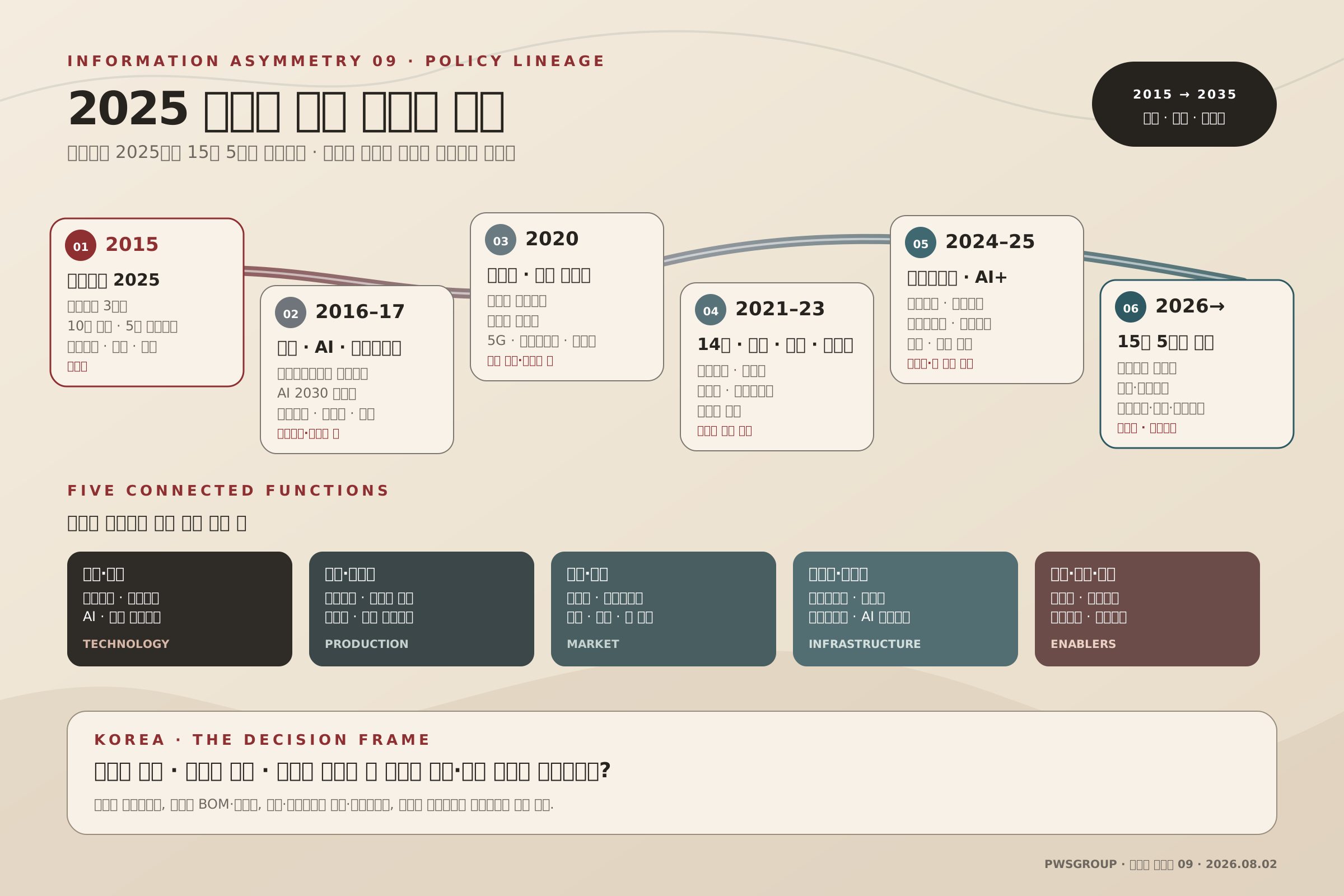
Made in China 2025 set a three-stage manufacturing-power roadmap, ten sectors and five projects. Its deeper legacy is an execution system: central direction, ministry instruments, local parks and scenarios, and company markets.
Innovation-driven development, AI and industrial internet expanded the task into basic research, networks, platforms, data and security. Documents multiplied, while digitalization, core technology and industrial-base tasks persisted.
Dual circulation combines domestic demand, international links, technology, supply chains and markets. New infrastructure supplied 5G, industrial internet, data centers and compute for smart manufacturing.
Dual carbon, the unified market, Digital China, new quality productive forces, future industries and AI+ added distinct green, market, data, productivity and application functions that combine with manufacturing strategy in the 15th Plan.
Core-technology gaps, weak effective demand, overcapacity and price competition, local duplication, data standards and external constraints remain. Korea should read the national–ministry–local–company policy stack to separate competition, cooperation and protection.
CHINA SYSTEM · EXECUTION STACK
The execution chain runs from national planning and ministry actions through local scenarios and finance to company orders.
Central authorities define long-term goals, five-year plans, macro frameworks and strategic boundaries.
NDRC, MIIT, science and data bodies translate direction into infrastructure, manufacturing, R&D, data and market instruments.
Provinces and cities combine parks, funds, talent, scenarios, procurement and anchor firms.
State and private firms, specialized SMEs, universities, finance and customers must close the loop from R&D to repeat purchasing.
BOTTLENECKS · RISK
Core technology · gaps in semiconductors, industrial machine tools, foundational software, metrology and some materials
Market · weak effective demand, overcapacity, price competition and receivables constrain monetization
Local execution · duplicated bets, subsidy dependence, fund efficiency and local protection
Data and external environment · data flows, standards, AI accountability, export controls and market access
The supplied lecture deck provided the starting map; policy relationships, targets and dates were cross-checked against Chinese primary texts. Link labels below remain in Korean; each link opens the cited Chinese or English original.