The original place
北京市海淀区中关村
The Zhongguancun Avenue and Haidian Huangzhuang area in northwest Beijing, beside Peking University, Tsinghua University and many Chinese Academy of Sciences institutes.

INFORMATION · UNDERSTANDING ZHONGGUANCUN
Zhongguancun is a neighborhood in Beijing’s Haidian District, a national innovation zone, a concentration of universities and research institutes, an enterprise-and-capital ecosystem, and a brand linking China with overseas hubs. The same name describes different layers.
Based on official Beijing, Haidian and Zhongguancun sources · Fully re-audited August 2, 2026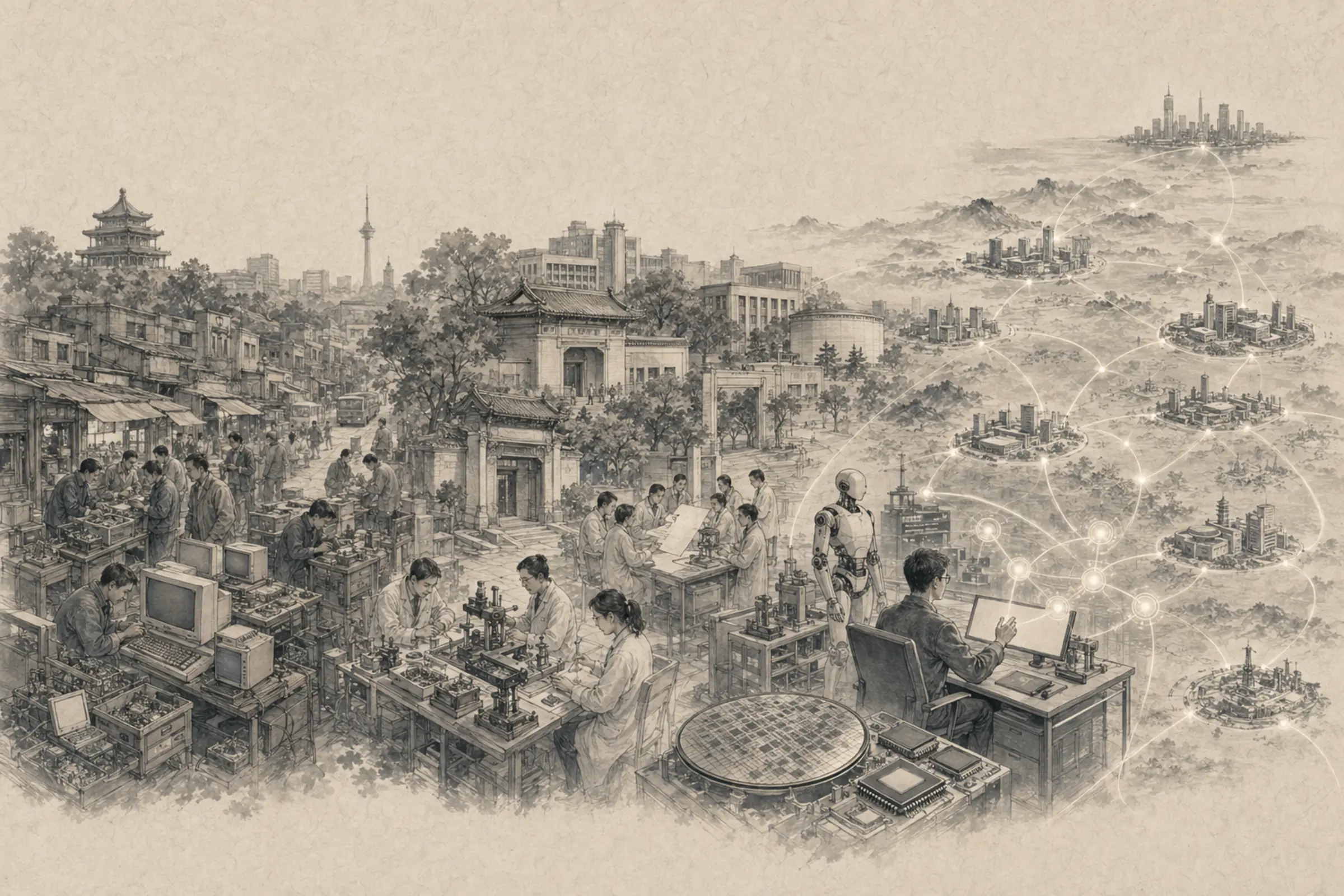
EDITORIAL THESIS
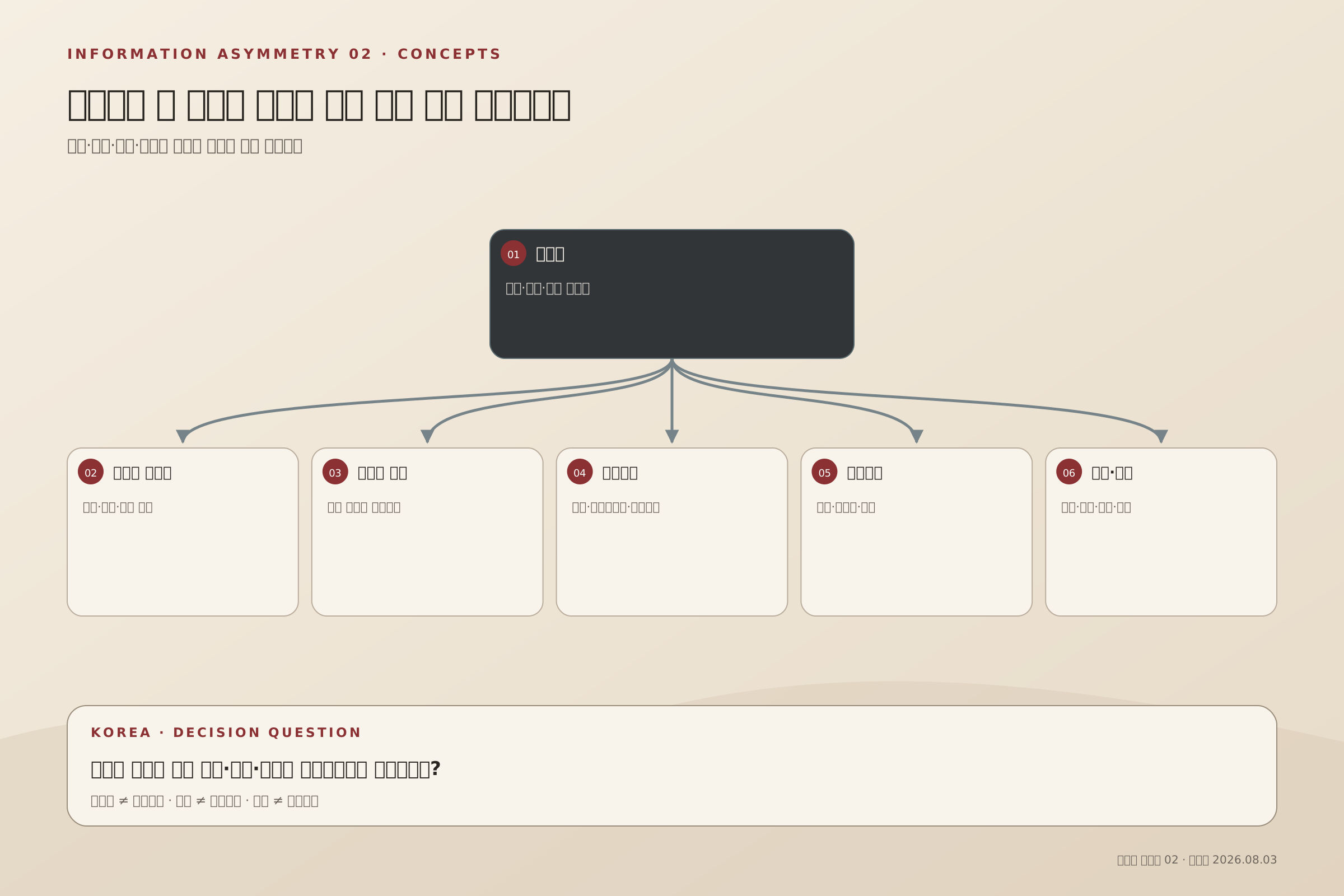
Zhongguancun is not one place but a network of policy zones, universities, institutes, firms and capital.
The Zhongguancun label alone does not identify authority, contracting entity or operating location.
Korea should identify technology owners, users, investors and operators, then design paths to pilots and procurement.
Swipe sideways for detail; tap the graphic to open it full size.
THE SHORT ANSWER
Zhongguancun did have a major era of PC assembly and electronics retail. Its deeper origin, however, was scientists bringing research to market. Today it operates more like a national innovation system connecting research, talent, policy, companies, capital and professional services.
北京市海淀区中关村
The Zhongguancun Avenue and Haidian Huangzhuang area in northwest Beijing, beside Peking University, Tsinghua University and many Chinese Academy of Sciences institutes.
中关村国家自主创新示范区
A 488 km² national demonstration zone with 16 sub-parks across all 16 Beijing districts—not just Haidian.
中关村创新生态
Universities, labs, startups, large companies, investors, incubators, technology services and policy experimentation working as a network.
中关村品牌与全球网络
Distinct organizations and platforms including the ZGC Forum, ZGC Group, Innoway, cooperation parks and overseas innovation centers.
FROM A STREET TO A SYSTEM
In 1980, Chinese Academy of Sciences researcher Chen Chunxian launched a technology-service organization. Scientists then left institutes and universities to form private technology firms, creating the Electronics Street. Large consumer electronics markets arrived later with the PC boom.
Electronics retail was a highly visible chapter, but Zhongguancun’s roots lie closer to research commercialization than to a retail district.Chen Chunxian and fellow researchers formed an advanced technology service unit, opening an early route from research to market.
Official ZGC historyNearly 100 technology firms clustered along an F-shaped corridor around Zhongguancun. The term initially described private technology enterprises, not only shops.
ZGC Demonstration ZoneThe State Council approved the Beijing New Technology Industry Development Experimental Zone, establishing a policy test bed.
Torch Center historyThe area became Zhongguancun Science Park in 1999. Hailong, Dinghao and e-World formed the retail ‘golden triangle’; market space exceeded 320,000 m² by 2009.
Rebirth of Zhongguancun AvenueZhongguancun became a national platform for experimenting with regulation, finance, talent and technology-transfer systems.
Official zone profileThe approved footprint expanded to 488 km² and 16 sub-parks covering all Beijing districts.
Official spatial scopeTraditional malls closed or transformed into spaces for technology transfer, smart hardware, technology finance and incubation.
Retail transformationBeijing Zhongguancun Academy, the AI Institute and the AI 40°N Community form a new education–research–commercialization chain.
World-leading science park planTHE CORE ENGINE · HAIDIAN
Haidian concentrates universities, national research organizations, new R&D institutions, leading corporations and startups in one connected environment.
Universities in Haidian
National laboratories
National key laboratories
New R&D institutions
Peking University, Tsinghua University, CAS institutes and national laboratories supply research and talent.
Proof-of-concept centers, transfer offices and new R&D institutions turn papers and patents into products and firms.
Lenovo, Baidu, Xiaomi and ByteDance coexist with AI, robotics and semiconductor startups.
Guidance funds, venture capital, guarantees, banks, IP, legal and incubation services support each growth stage.
Talent, research, procurement, data and commercialization rules are piloted while urban and industrial settings open to new technology.
WHO IS WHO · THE ZHONGGUANCUN NAME
Policy authorities, the Haidian execution body, a state-owned technology-services group, a national forum and market operators have different mandates.
THE NEW ZHONGGUANCUN · THE AI EXPERIMENT
The contemporary story is an education–research–commercialization–venture pipeline.
BEIJING ZHONGGUANCUN ACADEMY
The Beijing Zhongguancun Academy, jointly developed by the Ministry of Education and Beijing, held its first opening ceremony on September 13, 2024. The Zhongguancun AI Institute was established on October 28 and unveiled on November 29 under Beijing’s science commission. They collaborate as ‘two institutes in one’ but have different founding authorities and core functions.
ZHONGGUANCUN AI 40°N COMMUNITY
The Zhongguancun AI 40°N Community opened a 60,000 m² first-phase industrial campus in July 2025. The AI OPC service plan announced that December is based on a 6,000 m² dedicated incubator inside it. By July 2026, 300-plus applications, 70-plus formally admitted firms and 50-plus teams trained in two accelerator cohorts were separate populations and must not be added together.
BEYOND THE ORIGINAL VILLAGE
Beijing has sub-parks, other provinces have cooperation parks, and overseas locations have innovation centers and liaison nodes. Authority and operators differ.
Haidian is the core, while specialized parks in Changping, Shunyi, Daxing–Yizhuang, Huairou, Yanqing and other districts form the national demonstration zone.
Official spatial scopeOfficial 2021 figures identified 27 cooperation parks in 26 provinces and cities, including Tianjin Binhai–Zhongguancun, Jingjin Zhongguancun Tech City and Xiong’an Zhongguancun Science Park.
National cooperation networkZGC Group developed innovation centers in Silicon Valley, Heidelberg and Tel Aviv and service offices in cities including Toronto, Helsinki and Tokyo. Its Santa Clara center opened in 2016.
Overseas innovation networkCooperation parks and overseas centers are not automatic extensions of the Beijing committee’s administrative jurisdiction. They are local partnerships for technology transfer, investment, incubation and company services.
A PRACTICAL MAP · FOR KOREAN VISITORS
Define whether the goal is policy, research, companies, startups or investment before choosing the institution and place.
See the physical transition from Electronics Street to an innovation district.
Meet startup teams, accelerators, investors and international programs.
Understand project-based doctoral education, research and commercialization.
Observe current AI-native small-team and solo-founder experiments.
Registration location and project scope determine the responsible authority.
Execution sits with the investment, finance, space, transfer or overseas service operator.
PRIMARY SOURCES