
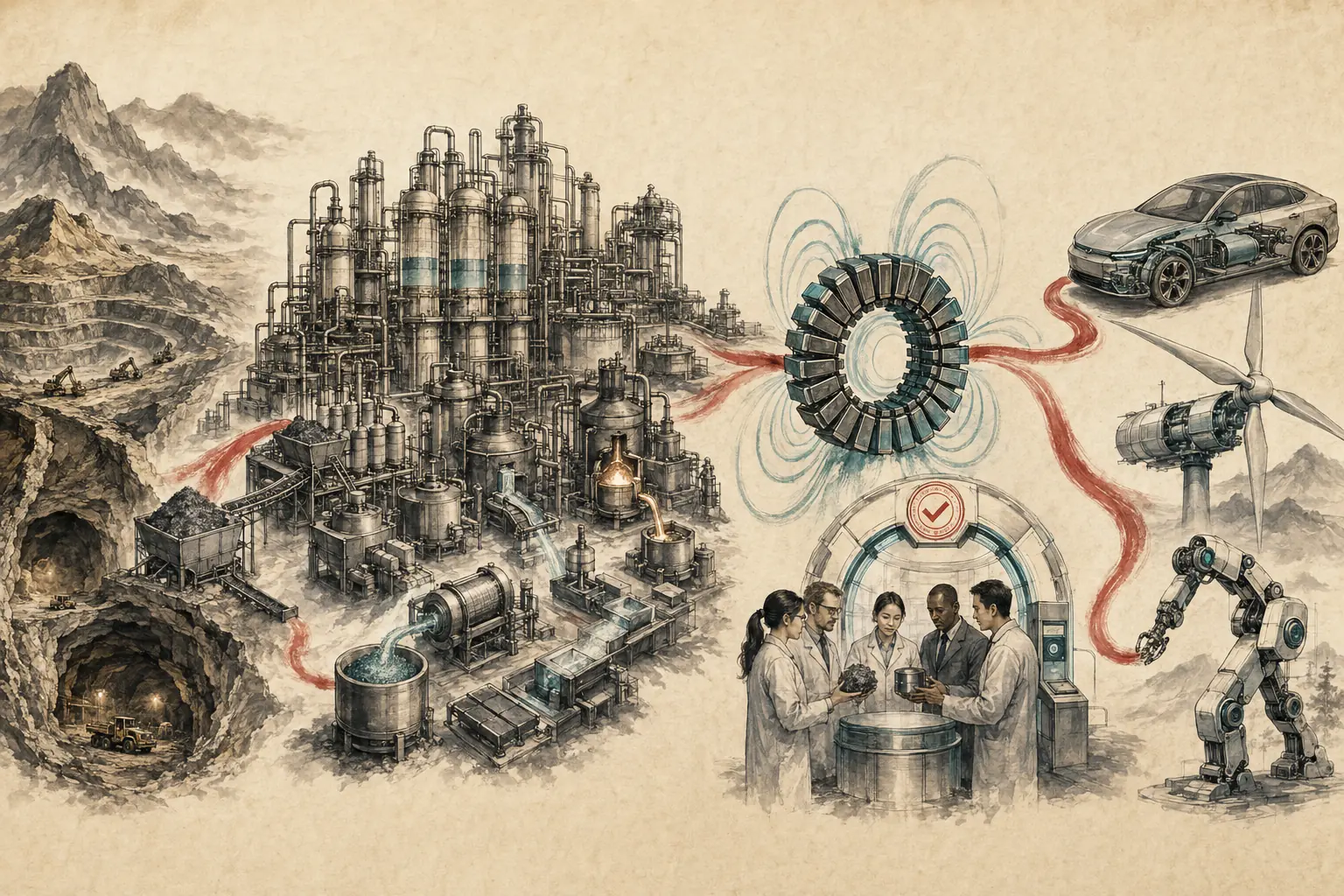
Modern ink-wash rare-earth chain from mine through separation to magnets and motors

INFORMATION ASYMMETRY 46 · MATERIALS · STRATEGIC SUPPLY CHAINS

Is Rare-Earth Competitiveness Decided Beyond the Mine?

稀土开采、冶炼分离、金属合金、永磁材料与出口管制

Separates elements and light/heavy rare earths while linking mining, separation, metals, magnets, motors, recycling, export controls and foreign cooperation.

Cross-checked against Chinese primary, industry, research and media sources · Editorial, SEO and image audit August 4, 2026 · Currency basis: the latest CFETS rate available on August 5, 2026—USD/CNY 6.7917, published August 4, 2026 · monetary amounts shown only in U.S. dollars
Topic typeSupply-chain × regulatory-risk

EDITORIAL THESIS

Core proposition

  1. 01

    Rare-earth power lies not in reserves alone but in continuous capability across separation, metals, magnets, customer qualification and recycling.

Swipe sideways for detail; tap the graphic to open it full size.

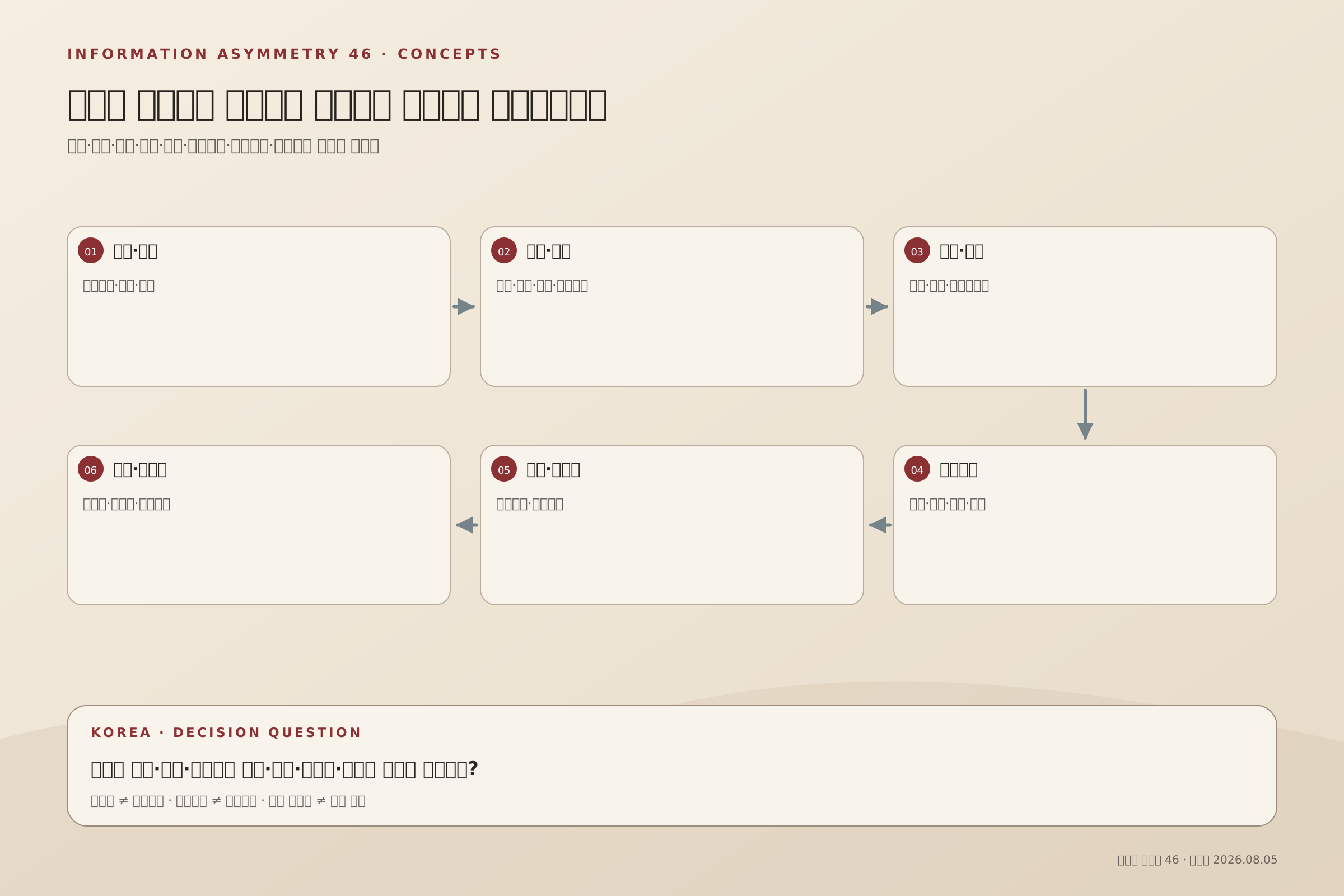
Infographic of the concept, operating structure, constraints and Korean response for Is Rare-Earth Competitiveness Decided Beyond the Mine?
46 · Operating structure — Is Rare-Earth Competitiveness Decided Beyond the Mine?A Korean-language graphic summarizing the concept, China’s operating system, constraints and Korea’s decision question.Download high-resolution SVG

CHINA SYSTEM · OPERATING LOGIC

Read the concept through its operating structure

01

Define the industrial essence and concept boundary

This section separates commonly confused labels, legal objects and business units so a policy label or single metric is not mistaken for a market outcome.

02

Map China’s system as an executable chain

This section links central rules, local execution, institutional permissions, company processes and transaction evidence to show how the system reaches operations.

03

Separate announcement, inputs, operations and outcomes

Targets, approved lists, funding, operation, customer adoption and cash flow are different stages and must be verified with consistent definitions.

04

Locate the real execution bottleneck

This section tests licences, capability, data, talent, customers, cost, accountability and exit conditions to locate the slowest, least substitutable constraint.

05

Judge outcomes by evidence, not scale narratives

Primary rules should be cross-checked with company records, contracts, finance, operating logs, user outcomes and independent research, with definitions, period and limits disclosed.

06

Translate the conclusion into a Korean decision

The conclusion allocates work across government, industry, universities, research, finance, users and intermediaries, ending with owners, evidence, timing and KPIs.

Primary, industry, research and media sources

The Korean primary report cross-checks Chinese official texts with industry, research and media evidence.

01Official희토류 관리조례 — 중국 국무원02Official희토류 관련 기술 수출통제 — 중국 상무부03Official중·중희토류 관련 물자 수출통제 — 중국 상무부04ResearchMineral Commodity Summaries 2026 — USGS05ResearchGlobal Critical Minerals Outlook — IEA06ResearchRare Earth Elements and Supply Chains — OECD07OfficialCritical Raw Materials Act — European Commission08IndustryRare Earth Magnet Market Analysis — Adamas Intelligence
Back to Information Asymmetry