Approved space
开发区 · Development zone
A broad category of industrial-development space approved by the State Council or a provincial government. The approval document and legal boundary matter more than the English name.

INFORMATION · CHINA INDUSTRIAL SPACES
Development zones, industrial parks, high-tech zones, economic and technological development zones, comprehensive bonded zones and pilot free trade zones are not labels at the same level. China’s industrial map becomes clearer only when industrial space, policy experimentation and customs-supervised boundaries are separated.
Official NDRC, MIIT, MOFCOM and GACC sources · Fully re-audited August 2, 2026
EDITORIAL THESIS
China's industrial zones are a combination of distinct approval, functional, customs and spatial regimes.
Management, land, utilities, logistics, customers and usable incentives matter more than a prestige label.
Korean firms should stage offices, entities, factories and bonded functions around validated demand and supply chains.
Swipe sideways for detail; tap the graphic to open it full size.
THE SHORT ANSWER
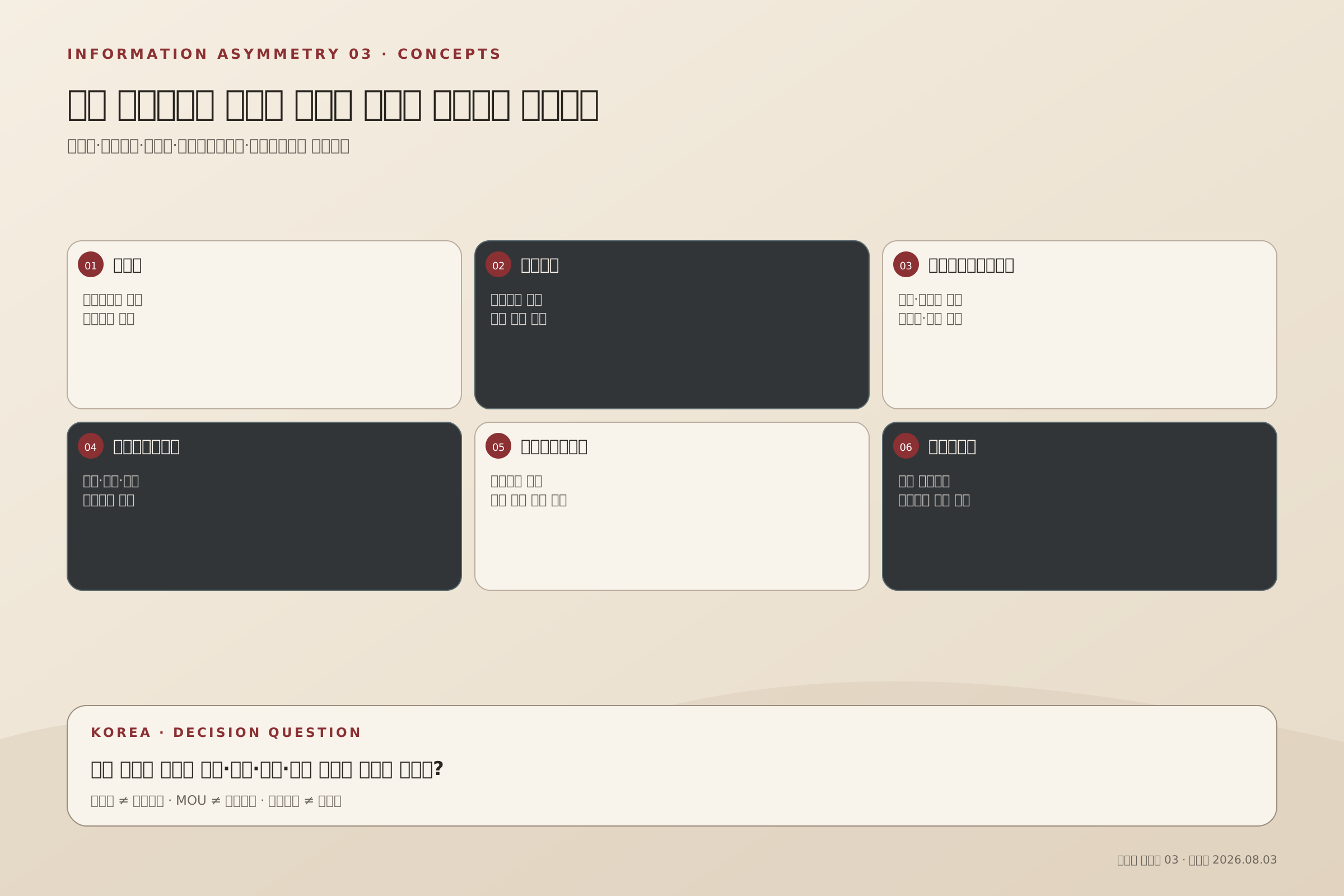
If Pangyo means a node where technology companies and R&D concentrate, China’s 178 national high-tech zones are the closest reference. For larger policy experimentation, there are 23 national innovation demonstration zones. For the broadest official industrial-space baseline, the 2018 directory listed 2,543 national and provincial development zones. These scopes differ and can overlap.
开发区 · Development zone
A broad category of industrial-development space approved by the State Council or a provincial government. The approval document and legal boundary matter more than the English name.
产业园区 · Industrial park
A broad term for an industry-focused park. It may describe a whole approved zone or a smaller specialist park inside one, so the name alone does not establish rank.
综合保税区 · Comprehensive bonded zone
A customs-supervised area for bonded processing, logistics and international trade. It may sit inside a development zone but is legally a different system.
自由贸易试验区 · Pilot free trade zone
A national space for testing investment, trade, finance and government-service rules. One PFTZ may have several non-contiguous subareas and overlap other zones.
WHO APPROVES WHAT
China generally reserves the creation, upgrading and boundary changes of formal development zones to central and provincial governments. City and county governments and management committees handle development, investment attraction and enterprise services. Even among national-level spaces, ETDZs, HTZs, new areas and PFTZs serve different missions.
The sequence national–provincial–city–county is not a simple quality ranking for firms or projects. It first identifies the approving authority, policy scope and management powers.Approved by the State Council or managed within a central-ministry system, these spaces carry national opening-up, technology or regional-development missions and undergo central evaluation.
NDRC explanation of development-zone approvalsApproved by a province, autonomous region or municipality to implement regional industrial and land-use plans. Strong performers may later seek national upgrading.
Hunan Province Development Zone RegulationOften locally established or branded specialist parks. Many are not a separate tier in the national directory and cannot be added to the 2,543-zone baseline.
NDRC Directory of China’s Development Zones (2018)A management committee is usually an agency dispatched by local government. A committee-plus-company model may marketize construction and operations; neither label is a separate city government.
Hunan Province Development Zone RegulationTHE NUMBERS · DIFFERENT NATIONAL BASELINES
The 2018 directory remains the broadest official baseline for national and provincial development zones. ETDZs, HTZs, innovation zones and bonded zones have continued to evolve and may overlap, so their counts should never be added together.
National + provincial development zones · 2018
National high-tech zones · 2024
National innovation demonstration zones
Comprehensive bonded zones · 2026
Opening-up platforms centered on foreign investment, trade, advanced manufacturing and producer services.
Innovation nodes for high-tech firms, R&D, commercialization and emerging-industry clusters.
Broader policy pilots built on 66 national HTZs and other carriers—not 23 standalone parks.
Mega-regions integrating urban development, industry, population, infrastructure and national strategy.
The current total after Inner Mongolia was added in April 2026, focused on institutional opening-up.
THE MAIN SYSTEMS
Spatial approval, industrial policy, customs supervision and regulatory experimentation can overlap. Read each approval, governing system, boundary and applicable policy separately.
BONDED IS A DIFFERENT AXIS
Bonded status describes goods held under customs supervision with import duties and taxes deferred under defined conditions. It therefore starts with customs treatment rather than the industry named on the park’s sign.
CUSTOMS SPECIAL SUPERVISION AREA
China developed six types of customs special supervision area: bonded zones, export processing zones, bonded logistics parks, bonded port zones, cross-border industrial zones and comprehensive bonded zones. Since 2015, the system has been consolidated around the comprehensive bonded-zone model.
BONDED SUPERVISION SITE
A customs-supervised site operated by one Chinese legal entity where multiple firms conduct bonded warehousing and logistics. It is legally and functionally narrower than a comprehensive bonded zone.
KOREAN REFERENCE POINTS
Chinese industrial spaces can layer land, industrial policy, investment attraction, urban development, customs and regulatory experimentation. The comparisons below are functional reference points only.
Often combines the physical role of a Korean national or general industrial complex with some investment and enterprise-service functions of a Free Economic Zone.
MOFCOM data on national ETDZsA useful combination of Pangyo Techno Valley, a technopark and an R&D special zone—while often including far more manufacturing.
State Council Information Office briefing on national HTZsLike a Korean Free Economic Zone it improves the international business environment, but it places greater weight on replicable regulatory experimentation.
MOFCOM briefing on the China (Inner Mongolia) Pilot FTZFunctionally close to Korea’s Free Trade Zones and bonded areas, with processing, logistics, repair and re-export inside one customs boundary.
GACC guide to comprehensive bonded zonesA national new area combines a new city, industrial node and national project, so its internal development zones must be assessed separately.
NDRC data on national new areas“China has 178 Pangyos” is only an introductory analogy for national HTZs. Their size, industries, powers and development stages vary widely.
FIELD VOCABULARY
For partnerships and investment, verify the approval, exact boundary, operator, leading industries, customs status and legally applicable incentives.
Confirm whether each sub-park is inside the approved boundary and shares the same policies.
Start with the approval and powers of the parent zone.
Identify who controls land, permits, taxation and enterprise services.
It may not be a national qualification; separate the approved zones inside it.
Verify actual tenants, research platforms, available space and policy authority.
Map the supply chain across cities and development zones.
OFFICIAL SOURCES