Embodied intelligence
具身智能
Integrates perception, reasoning and action through interaction between a body and its environment; overlaps with, but is not identical to, Physical AI.

INFORMATION ASYMMETRY · AI, PHYSICAL AI & EDUCATION
A source-based guide to embodied-intelligence research and entrepreneurship at leading universities, major redesign at ordinary institutions, and practice-led change in vocational education.
Official ministry, government and university sources · Fully re-audited August 2, 2026
EDITORIAL THESIS
China's university AI shift combines literacy, program redesign, hardware practice and industry research.
Faculty startups, university incubation, institute spinouts and university equity are different relationships.
Korea should measure industry projects, shared equipment, jobs, transfer and paid pilots—not department counts.
Swipe sideways for detail; tap the graphic to open it full size.
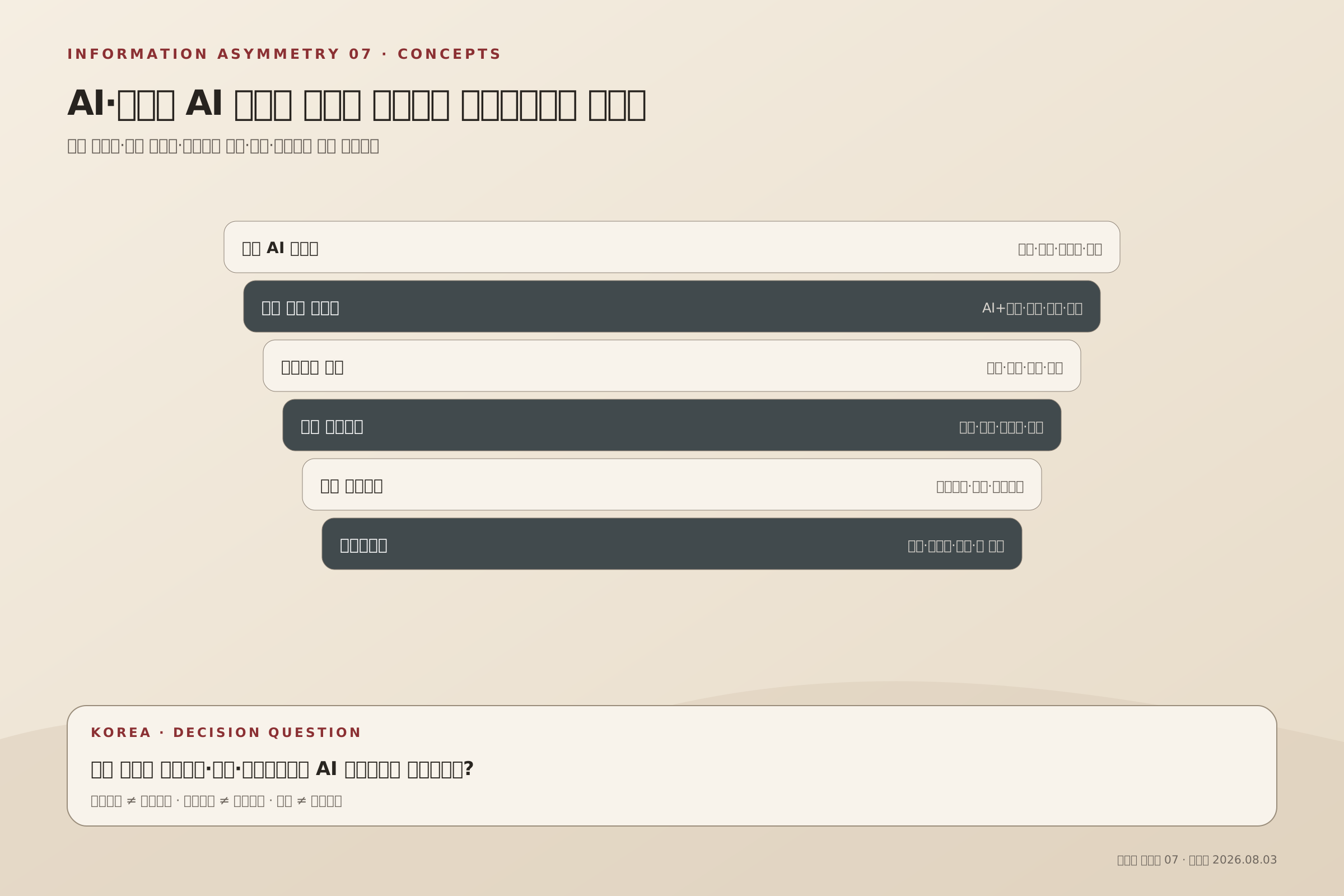
Physical AI is used here as a broad explanatory term. Chinese policies and universities more often use embodied intelligence, intelligent robots, humanoid robots, intelligent manufacturing and unmanned systems. They overlap but are not exact synonyms.
Beijing, the Yangtze River Delta and the Greater Bay Area provide different research, manufacturing and startup environments. Locations do not imply a ranking.
具身智能
Integrates perception, reasoning and action through interaction between a body and its environment; overlaps with, but is not identical to, Physical AI.
人工智能+ / AI+X
Embeds AI into existing fields such as engineering, materials, medicine, transport, management and the arts.
微专业
Usually a short, non-degree cluster of courses or skills credential; credit and assessment vary by institution.
现代产业学院
A university-industry platform for joint curriculum, mentors, facilities and projects—not usually an independent university.
人形机器人
A hardware form factor resembling the human body; shape alone does not prove embodied intelligence or autonomy.
未来机器人
An interdisciplinary major in China’s undergraduate catalogue; delivery capability must still be checked institution by institution.
AI literacy, major redesign, micro-programs, interdisciplinary institutes, hardware projects and commercialization are moving together at different levels.
Common learning in AI principles, limits, ethics, data and disciplinary use.
Uses new, resized, suspended and abolished programs to fit mission and regional demand.
Adds AI, robotics and data skills without requiring students to change degrees.
Connects mechanics, control, electronics, computing, materials and cognition around embodied systems.
Trains sensing, control, embedded systems, vision, safety and integration on real hardware.
Links lab work, pilot testing, validation, transfer and startups while preserving legal distinctions.
We distinguish prototypes, faculty startups, university-project incubation, research-institute spinouts and corporate joint labs.
南方科技大学
ShenzhenA visible chain from AI literacy and formal majors to robotics research and a faculty startup.
华南理工大学
GuangzhouIts strength is engineering-wide AI+ integration and industry-project education.
西湖大学
HangzhouCombines small-cohort early research, AI+Science and lab-level embodied intelligence.
中国科学院大学
Beijing and the CAS institute networkIts core model combines degree education with the Chinese Academy of Sciences institute network.
上海科技大学
ShanghaiLinks an AI honors track, the STAR robotics center and a broader transfer system.
清华大学
BeijingRuns core AI research, university-wide AI+ education and a new embodied-intelligence institute in parallel.
浙江大学
HangzhouCombines AI+X curricula with joint engineer training on real robots.
The pattern is portfolio rebalancing based on mission, regional industry and employment—not a blanket conversion to AI degrees.
Rebalances programs around regional industry, demand, employment, faculty and facilities.
Provincial universities proposed AI, intelligent-manufacturing and low-altitude programs alongside closures; proposals, approvals and enrollment are distinct.Provides common literacy first, then adapts data, tools and ethics to each discipline.
Zhejiang Normal University offers a university-wide AI introduction; national policy calls for common plus specialized AI courses.Adds interdisciplinary skills faster than redesigning a full degree.
The MOE’s Double-Thousand program reported 2,654 micro-programs and about 74,000 2025 graduates; these are generally non-degree supplements.Changes data, labs, projects and assessment inside existing engineering and non-engineering degrees.
Changsha University of Science and Technology grouped four majors around industrial embodied intelligence; Shanghai Institute of Technology pursues both AI+ and +AI.New, suspended and abolished programs move together, and not all adjustment is caused by AI.
신규 전공 설치점
모집정지 전공 설치점
폐지 전공 설치점
일반대 학부 전공
일반대 학부 전공
체화지능 전공 첫 승인 대학
Their focus is closer to installation, commissioning, integration, operation, maintenance and deployment, supported by teachers, labs, industry projects and safety systems.
中等职业教育
Builds fundamentals in mechanics, electronics, safety, operation and basic maintenance.Connects automated equipment, sensors, PLCs and basic robot operation to work procedures高职专科
Emphasizes installation, commissioning, integration, operations, maintenance and deployment.Intelligent robot technology, industrial robot technology and applied AI职业本科
Targets systems integration, process improvement, applied innovation, technology transfer and field engineering.Intelligent manufacturing engineering, robotics and newly added embodied-intelligence engineeringA university name in a company profile does not prove equity ownership or direct incubation. Contracts, registration and official records matter.
A joint lab, course or equipment relationship does not mean the university created the firm.
ShanghaiTech × Fourier IntelligenceThe founder-university affiliation is verified; equity or direct incubation needs separate evidence.
Zhejiang–DeepRoboticsThe university officially states that the company grew from a university project or research, beyond founder affiliation alone.
SUSTech–LimX Dynamics · Tsinghua IIIS–RobotEraAn institute in the same system incubated the company, but the university legal entity may be different.
CAS Shenyang Institute–SIASUNThe strongest claim, requiring registry, disclosure or investment documents proving ownership or control.
Do not use this label without verified evidenceCurriculum, faculty, equipment, real projects and graduate outcomes matter more than program names and MOU counts.